Introduction
AI can absolutely help you move faster when you are starting a new product. It can generate wireframes, suggest page layouts, draft app screens, and help founders explain an idea visually. That makes it useful at the ideation stage.
But there is an important reality founders should understand early: generating a few screens is not the same thing as building a working website or mobile application. AI can help with direction, but shipping a reliable product still requires a team.
What AI Is Good At in Early Product Work
When used well, AI is a strong acceleration layer for the first phase of product planning. It helps reduce blank-page anxiety and gives teams something concrete to react to.
- It can create basic wireframes and screen ideas quickly.
- It can help founders communicate flows before development starts.
- It can draft rough copy, navigation ideas, and feature lists.
- It can give developers an early visual reference for the intended direction.
That is useful. It improves alignment. It saves time. It helps everyone start from a clearer idea.
What AI Does Not Finish for You
The gap between a generated UI and a production-ready product is where most of the real work lives. A proper digital product needs coordinated specialist execution across multiple layers.
- UI/UX: refining flows, edge cases, states, accessibility, and conversion paths.
- Frontend: building responsive interfaces, forms, validations, loading states, and reusable components.
- Backend: APIs, database design, business logic, auth, and data integrity.
- Integrations: payment gateways, CRMs, document tools, analytics, notifications, and third-party services.
- Code Quality: maintainable structure, testing, release safety, and long-term scalability.
- Security: access control, input handling, auditability, and protection of sensitive business data.
This is why AI-generated wireframes should be treated as a starting point, not as the finished product plan.
One Screen Is Not a System
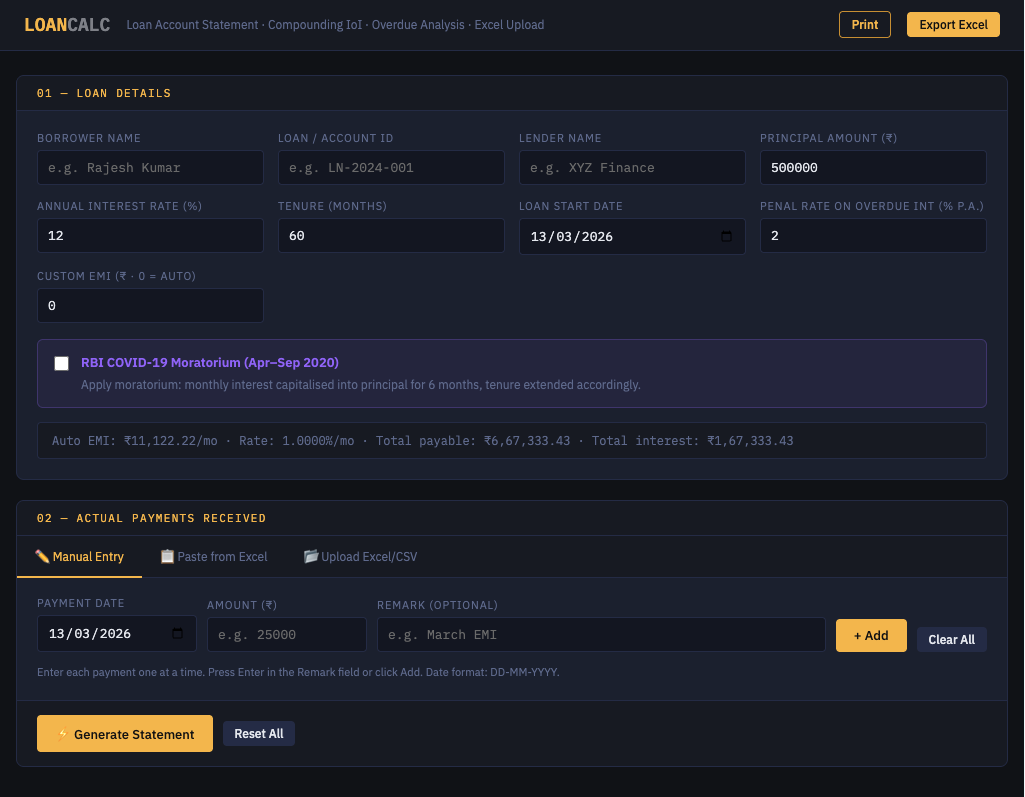
We recently worked with a client who had already designed the UI for a loan EMI calculator. The screen looked clear enough, and at first glance it seemed like the product was mostly figured out.
But the design alone did not answer the real implementation questions: how calculations should be validated, how overdue interest should behave, how statements should be generated, how Excel imports should be parsed, and how the underlying data should be stored and exported safely.
What the Next Step Actually Looks Like
Once a concept screen is ready, the real product work begins. A team has to translate that visual idea into system behavior, data flow, and reliable user operations.
- Define the calculation logic for EMI, overdue interest, and payment schedules.
- Structure borrower, lender, account, and transaction data correctly.
- Build manual entry, Excel import, and export-ready flows.
- Handle validation, formatting, failure states, and edge-case calculations.
- Prepare print-ready outputs and operational reporting.
That is the difference between a nice concept and a usable business tool.
How Craftnotion Took It From UI to Product
In this case, Craftnotion took over from the UI stage and built the full system around it in 48 hours. The client did not need another surface-level mockup. They needed the actual product logic, workflow handling, and implementation support that turns a static design into working software.
That meant moving beyond the visual layer into architecture, interface behavior, calculations, data structure, and delivery execution. Speed mattered, but correctness mattered more.
The Realistic Way to Use AI in Product Development
The best use of AI is not pretending it replaces the team. The best use is letting it accelerate the early clarity phase while specialists take responsibility for execution.
AI can help you show the idea. A strong product team makes the idea usable, scalable, secure, and ready for real users.
Final Thoughts
If you are trying to generate a website or mobile application using AI, use it to get faster visual clarity and faster product conversations. Just do not confuse generated screens with a finished build plan.
At Craftnotion, we help founders bridge that gap. We take rough concepts, wireframes, or client-designed screens and turn them into complete systems with the design, development, integration, and technical quality needed to ship.
If you already have screens or an AI-generated concept, talk to Craftnotion and we can help turn it into a real product.